Stainless Steel
Stainless Steel Precision Valve Stems & Plungers
EADAmetal focuses on the custom manufacturing of stainless steel precision valve stems, plungers, spool pins, and small-diameter shaft parts according to customer drawings.[cite: 9]
We provide end-to-end solutions: material procurement, precision turning, pre-plating dimension control, hard chrome plating, electroless nickel plating (ENP), post-plating fine grinding, final inspection, and finished product delivery.[cite: 9]
Our Core Focus:[cite: 9]
We solve critical issues regarding dimensions, roundness, coaxiality, surface roughness, and coating thickness that easily occur during the manufacturing of precision reciprocating parts.[cite: 9] We primarily support prototypes, small batches, and repetitive batch orders, focusing on projects ranging from 500 to 10,000 pieces per batch.[cite: 9]
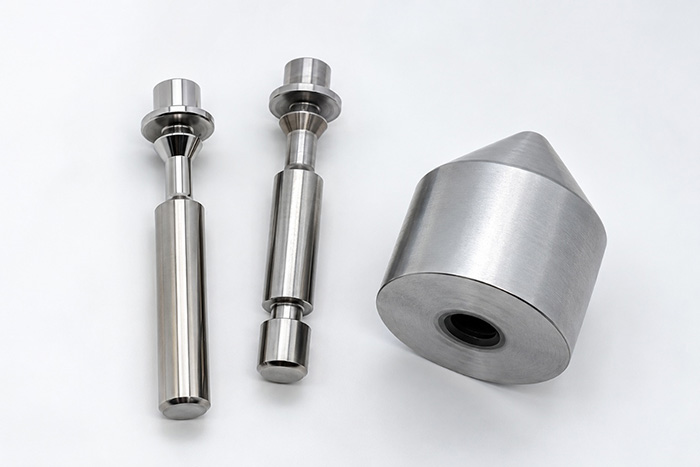
Primary Parts We Manufacture
These parts typically operate under corrosion, friction, reciprocating motion, sealing fits, or long-term cyclic conditions, demanding high precision and surface quality.[cite: 9]
- Solenoid valve stems[cite: 9]
- Hydraulic valve stems[cite: 9]
- Pneumatic valve stems[cite: 9]
- Precision plungers[cite: 9]
- Spool pins & guide pins[cite: 9]
- Spool valves & poppet valves[cite: 9]
- Pilot pins[cite: 9]
- Solenoid armature parts[cite: 9]
- Hard chromed precision shafts[cite: 9]
- Reciprocating parts with seal grooves[cite: 9]
- Other small precision functional parts[cite: 9]
Capabilities We Provide
- Stainless steel bar & wire procurement[cite: 9]
- Precision CNC turning (ODs, end faces, steps, tapers)[cite: 9]
- Machining of seal grooves, circlip grooves & undercuts[cite: 9]
- Drilling, tapping, and thread processing[cite: 9]
- Pre-plating pre-grinding & machining allowance control[cite: 9]
- Hard Chrome & Electroless Nickel Plating (ENP)[cite: 9]
- Post-plating centerless & cylindrical fine grinding[cite: 9]
- Precision polishing & surface roughness control[cite: 9]
- Inspection of dimensions, roundness, runout, and coating thickness[cite: 9]
Mastering the Dimensional Chain
For precision valve stems requiring hard chrome plating, the final dimension cannot rely solely on mechanical machining or electroplating alone.[cite: 9] EADAmetal controls the entire process as an integrated dimensional chain.[cite: 9]
Why is Pre-Plating Control Critical?
If the pre-plating size is too large, there won't be enough grinding space afterward.[cite: 9] If it is too small, the plating thickness must increase, raising costs and plating risks.[cite: 9] Uneven plating distribution can also impact roundness, coaxiality, and final grinding efficiency.[cite: 9]
- Determine pre-plating dimensions backwards from final sizes[cite: 9]
- Determine plating reserves based on substrate state & grind requirements[cite: 9]
- Control coating thickness and edge distribution[cite: 9]
- Retain reasonable allowance for post-plating grinding[cite: 9]
Common Stainless Steel Grades
| Grade / Equivalent Standards | Primary Performance Characteristics | Typical Applications |
|---|---|---|
| 303 Free-Machining AISI 303, EN 1.4305, JIS SUS303[cite: 9] |
Good machinability, ideal for auto-turning and high-volume machining.[cite: 9] Lower corrosion resistance than 304.[cite: 9] | Precision turned parts, valve stems, threaded parts, pins, instruments.[cite: 9] |
| 304 / 304L AISI 304/304L, EN 1.4301/1.4307[cite: 9] |
Good overall corrosion resistance, toughness, and formability.[cite: 9] 304L resists intergranular corrosion after welding.[cite: 9] | General valve stems, plungers, food equipment, general corrosion parts.[cite: 9] |
| 316 / 316L AISI 316/316L, EN 1.4401/1.4404[cite: 9] |
Contains Molybdenum.[cite: 9] Superior pitting and chloride corrosion resistance compared to 304.[cite: 9] 316L for severe environments.[cite: 9] | Chemical valves, marine equipment, fluid control, medical devices.[cite: 9] |
| 410 AISI 410, EN 1.4006, JIS SUS410[cite: 9] |
Strength and hardness can be increased via heat treatment.[cite: 9] Good wear resistance.[cite: 9] | Valve stems, pump shafts, pins, fasteners, mechanical parts.[cite: 9] |
| 420 Series AISI 420, EN 1.4021/1.4028, JIS SUS420J1/J2[cite: 9] |
Achieves high hardness and wear resistance after heat treatment.[cite: 9] Moderate corrosion resistance.[cite: 9] | Wear-resistant stems, shafts, plungers, tooling, precision parts.[cite: 9] |
| 431 AISI 431, EN 1.4057, JIS SUS431[cite: 9] |
Balanced strength, toughness, and corrosion resistance.[cite: 9] Ideal for shaft components.[cite: 9] | High-strength valve stems, pump shafts, load-bearing pins.[cite: 9] |
| 17-4PH (630) AISI 630, EN 1.4542, JIS SUS630[cite: 9] |
Precipitation hardening stainless steel.[cite: 9] Offers high strength, hardness, and good corrosion resistance.[cite: 9] | High-strength valve stems, petroleum equipment, control valves.[cite: 9] |
| 440C AISI 440C, EN 1.4125, JIS SUS440C[cite: 9] |
Extremely high hardness and wear resistance post-heat treatment, but difficult to machine.[cite: 9] | High-wear spools, shafts, bearing parts, precision motion parts.[cite: 9] |
| 2205 Duplex UNS S32205/S31803, EN 1.4462[cite: 9] |
Excellent strength and chloride corrosion resistance.[cite: 9] Machining difficulty is higher than 304/316.[cite: 9] | Marine, chemical, oil/gas equipment, high-corrosion environment valves.[cite: 9] |
Note: International standards are corresponding or approximate references and cannot always be directly interchanged.[cite: 9] Actual material selection must be confirmed based on customer drawings, execution standards, chemical compositions, mechanical properties, heat treatment hardness, and working mediums.[cite: 9]
Valve Stem Material Selection Guide
Environment Focus
- General/Industrial: 304, 304L[cite: 9]
- Chemical/Chlorides: 316, 316L[cite: 9]
- High Chloride/Corrosion: 2205 Duplex[cite: 9]
Mechanical Focus
- High Machining Volume: 303[cite: 9]
- Heat Treated Strength: 410, 420, 431[cite: 9]
- Extreme Hardness/Wear: 440C[cite: 9]
Compound Focus
- Strength + Corrosion: 17-4PH[cite: 9]
- Selection must also consider: Machinability, magnetic requirements, surface treatment adaptability, final hardness, and post-plating grindability.[cite: 9]
Surface Treatments: Hard Chrome vs. ENP
Hard Chrome Plating
Increases surface hardness, wear resistance, and anti-galling ability of stainless steel stems and plungers.[cite: 9] The required final size and surface roughness are obtained through post-plating grinding.[cite: 9]
Ideal For:
- High-frequency reciprocating motion[cite: 9]
- Sliding surfaces contacting seals[cite: 9]
- Precision plungers and small shafts[cite: 9]
- Parts requiring post-plating precision grinding[cite: 9]
Electroless Nickel Plating (ENP)
Does not rely on external current, providing relatively uniform coatings on complex shapes.[cite: 9] Enhances corrosion resistance, surface hardness, and wear resistance.[cite: 9]
Ideal For:
- Precision spools and valve stems[cite: 9]
- Complex stepped shafts, inner bores, or grooves[cite: 9]
- Reducing excessive coating buildup at sharp corners/edges[cite: 9]
- High emphasis on coating thickness uniformity[cite: 9]
Process Note: Stainless steel has a stable passivation film; appropriate activation and pre-treatment are required before hard chrome plating to ensure adhesion.[cite: 9] For heat-treated martensitic or precipitation hardening stainless steels, post-plating hydrogen embrittlement relief may be required depending on strength/hardness and client standards.[cite: 9]
Post-Plating Grinding & Quality Management[cite: 9]
Hard chromed valve stems typically undergo centerless or cylindrical fine grinding to achieve their final dimensions.[cite: 9] Proper wheel selection, grinding parameters, and cooling conditions reduce risks of coating burns, grinding cracks, chatter marks, and local peeling.[cite: 9]
Key Grinding Controls:[cite: 9]
- Final outer diameter, roundness, & cylindricity[cite: 9]
- Straightness, coaxiality, & radial runout[cite: 9]
- Integrity of the coating after grinding[cite: 9]
- Surface roughness of sealing zones[cite: 9]
- Transition locations at steps and ends[cite: 9]
Project Responsibility[cite: 9]
While material procurement and some CNC turning may be handled by vetted long-term manufacturing partners, EADAmetal acts as the primary responsible entity.[cite: 9] We manage drawing reviews, dimensional chain design, plating control, final grinding, inspection documents, and quality traceability.[cite: 9]
Inspection & Documentation[cite: 9]
- Material certs & heat treatment hardness[cite: 9]
- Length, OD, step, groove, & thread inspections[cite: 9]
- Roundness, straightness, & coaxiality[cite: 9]
- Surface roughness & defect checks[cite: 9]
- Coating thickness & final dimension checks[cite: 9]
- First Article Inspection (FAI) reports[cite: 9]
- Surface treatment & final inspection reports[cite: 9]
- Special tests (corrosion, hardness) per project[cite: 9]
Get a Precision Valve Stem Quote
EADAmetal will provide a comprehensive solution covering materials, precision machining, surface treatment, post-plating grinding, and quality control based on your part's structure, kinematics, and environment.[cite: 9]
Submit Project DetailsRFQ Information Needed:[cite: 9]
- 2D Drawings & 3D Models[cite: 9]
- Stainless grade & material state[cite: 9]
- Heat treatment & hardness reqs[cite: 9]
- Batch qty & annual volume[cite: 9]
- Final OD & tolerances[cite: 9]
- Roundness, straightness, runout[cite: 9]
- Surface roughness reqs[cite: 9]
- Hard Chrome or ENP spec[cite: 9]
- Coating thickness[cite: 9]
- Post-plating grinding required?[cite: 9]
- Masking & non-plated zones[cite: 9]
- Working medium & temperature[cite: 9]
- Sealing type & motion type[cite: 9]
- Required QA documents[cite: 9]