Defense
Military Surface Treatment Technologies
Advanced Coatings & Substrate Finishes
Military surface treatments encompass a highly regulated suite of chemical, electrochemical, and mechanical processes. Unlike commercial finishes, military-grade surface treatments must comply with rigorous defense standards—such as US MIL-SPEC and UK DEF STAN—to guarantee absolute reliability, corrosion resistance, low visibility, and biochemical defense in extreme operational environments.
Chemical & Electrochemical Treatments
Anodising (Chromic, Sulphuric, TSA)
Widely used for military aircraft structures and helicopter components. It thickens the natural aluminum oxide layer to provide exceptional wear resistance and corrosion protection.
Chromate Conversion Coatings (Chem Film)
Provides an excellent, electrically conductive corrosion barrier and acts as a superior primer base for weapons, ammunition, and naval hardware.
Alloy Plating (Zinc-Nickel & Cadmium)
Modern platforms have largely transitioned to high-performance Zinc-Nickel (Zn-Ni) plating, delivering equivalent marine anti-corrosion properties while meeting strict health and safety regulations.
Phosphate Conversion (Parkerizing)
Utilizes a phosphoric acid reaction to transform steel surfaces into a dense crystalline layer. It provides a matte finish, prevents rust, and retains protective lubricants on firearms.
Surface Hardening & High-Performance Paint
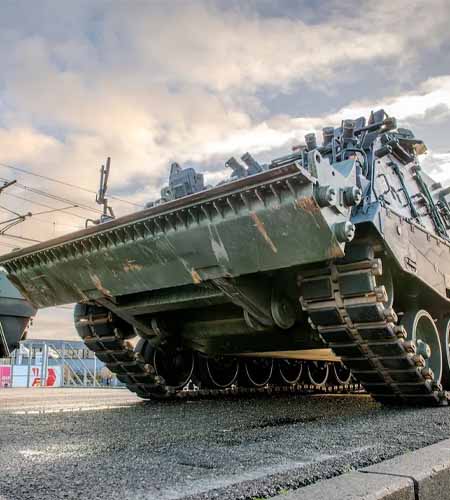
Chemical Agent Resistant Coating (CARC)
A critical requirement for tactical land vehicles. It creates a non-porous surface that prevents chemical, biological, or radioactive contaminants from penetrating the substrate.
Liquid Nitriding (CLIN / ARCOR)
Diffuses nitrogen into steel surfaces to maximize fatigue strength, minimize friction, and prevent seizing in high-stress parts like firearm barrels and landing gear.
Thermal Spray Coatings
Applies nanostructured composites via high-velocity oxygen fuel (HVOF) or plasma spraying, providing superior heat dissipation and wear shielding for missile exhausts.
Low-Reflectivity & Camouflage Coatings
Specialized matte and satin topcoats designed to drastically reduce light reflection and infrared signatures, allowing assets to evade detection in tactical environments.
Surface Preparation & Pre-Treatment
Dry Media Stripping
Uses aircraft-approved plastic media or abrasive blasting to strip old finishes and rust without gouging the sensitive metal beneath.
Hydro Blasting
Employs ultra-high-pressure water jets to flush away salt deposits, oil, and loose dirt from naval ship hulls without generating toxic dust.
Laser Cleaning
A precise, touchless method used to ablate surface contaminants, oxides, and coatings using targeted laser energy pulse systems.
Military Surface Treatment Overview
| Category | Key Technologies | Defense Application | Primary Benefit |
|---|---|---|---|
| Anodising | CAA, SAA, TSA | Airframes, aerospace parts | Wear resistance, paint adhesion |
| Plating | Zinc-Nickel, Gold, Tin | Naval systems, military electronics | Extreme corrosion protection, conductivity |
| Conversion | Chromate Film, Parkerizing | Firearms, ammunition, hardware | Lubricant retention, rust transformation |
| Specialist Paint | CARC, Low-Reflectivity Alkyds | Tanks, tactical transport, field gear | Biochemical defense, visual stealth |
| Hardening | Nitriding, Thermal Spray | Gun barrels, landing gear, engines | Anti-seizure, thermal stability |