Hydraulic System
Surface Treatments in Hydraulic Control
Wear Mitigation, Corrosion Defense & Fluid Tightness
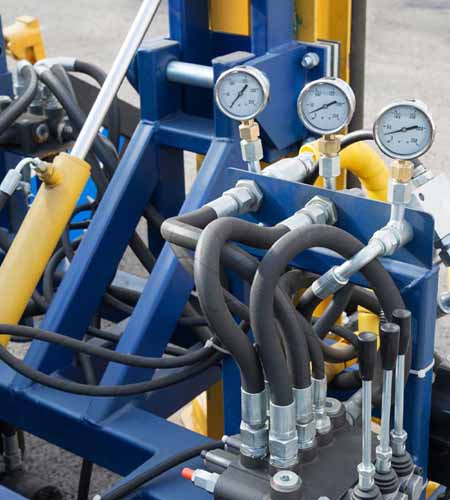
Hydraulic control systems operate under extreme conditions, including high pressures, aggressive fluid cavitation, and tight mechanical tolerances. Surface treatments are critical to prevent fluid leakage, optimize seal lifespan, minimize frictional hysteresis, and protect core components like valves, cylinders, and pistons from abrasive wear and environmental corrosion.
Rod & Cylinder Bore Coatings
Hard Chrome Plating (HCP)
The traditional standard for hydraulic cylinder rods. It provides high micro-hardness and a low coefficient of friction, ensuring smooth stick-slip-free strokes and good seal compatibility.
High-Velocity Oxygen Fuel (HVOF)
A thermal spray alternative to chrome plating, utilizing cermet materials like Tungsten Carbide-Cobalt Chrome (WC-CoCr). It delivers vastly superior wear, impact, and saltwater corrosion resistance.
Laser Cladding
Applies high-performance alloys using a localized laser heat source. This creates a true metallurgical bond with minimal dilution, perfect for heavy-duty marine and mining hydraulic rods.
Electroless Nickel Plating (ENP)
Deposits a uniform nickel-phosphorus layer on internal valve channels and complex geometries. It guarantees total coverage and excellent resistance against acidic or degraded hydraulic oils.
Hardening & Low-Friction Films
Ferritic Nitrocarburizing (FNC)
A thermochemical process that diffuses nitrogen and carbon into valve spools and housings. It increases surface hardness, prevents adhesive galling, and maintains precise control tolerances.
Diamond-Like Carbon (DLC) Coatings
An ultra-thin, low-friction carbon film applied via PVD. It is ideal for high-speed hydraulic pump pistons and proportional valve spools to eliminate response delay and prevent dry-run scuffing.
Manganese Phosphating
Applied to cast iron blocks, gears, and internal valving. It improves break-in behavior, absorbs hydraulic oil to maintain a boundary lubrication layer, and prevents initial metal-on-metal seizing.
Anodizing (Hardcoat / PTFE-Impregnated)
Transforms aluminum hydraulic manifolds and valve blocks into hard, wear-resistant blocks. Impregnation with PTFE further slashes friction for seals moving across aluminum bores.
Critical Performance Factors
Surface Roughness (Ra)
Controlled micro-finishing (usually Ra 0.1 to 0.4 µm) is vital. Too rough destroys elastomeric seals; too smooth prevents oil retention, leading to seal dry-burn.
Cavitation Resistance
High velocity fluid drops can implode, creating micro-jets that erode metal. Hard cermets and nitrided layers absorb these micro-shocks to protect valve orifices.
Hydrogen Embrittlement
Electroplating lines must manage hydrogen absorption during processing to avoid sudden, catastrophic cracking of high-pressure hydraulic manifolds.
Hydraulic Treatment Matrix
| Treatment Type | Target Component | Operating Constraint Addressed | Primary Purpose |
|---|---|---|---|
| HVOF (WC-CoCr) | Piston Rods (Offshore/Mining) | Salt spray, airborne particulate impact | Extreme corrosion & abrasive wear shielding |
| Hard Chrome Plating | Standard Hydraulic Cylinders | Dynamic sealing wear, linear friction | Smooth seal travel, economical hardness |
| Ferritic Nitrocarburizing | Control Valve Spools, Sleeves | Fine particle silting, high-frequency cycle wear | Anti-galling, high dimensional stability |
| DLC (PVD Coating) | Piston Pumps, Proportional Valves | Low-lubricity fluids, high-speed hysteresis | Near-zero friction coefficient, anti-scuffing |